Sunday, 23 December 2012

Krampus


ORIGIN
He is mainly in the folklore of the Alpine Countries, although he has his roots in Germanic folklore.
 
FIRST SIGHTED/RECORDED
His history reaches as far back as Pre Christian Germanic traditions go.
 
APPEARANCE
He is a beast like creature with a very demonic appearance. He is very hairy, usually black or brown. He also has cloven hoofs and the horns of a goat (some say he is actually that of a goat). He is also depicted as having a long protruding tongue. His appearance usually depends on what region you are hearing it from but it is generally all the same.
 
GENDER
Male
 
ALSO KNOWN AS
Grampus (meaning "Claw" in Old German), Klaubauf, Black Peter (Austria) Barti/Bartel, Niglobartel, Wubartl (Southern Austria) Pelzebock, Pelznickel (Southern Germany) Gumphinckel (Silesia) Krampusz (Hungary) Schmutzli (Switzerland) and many more.
 
REPELLED BY
There is nothing that they seem to be repelled by.
 
MAGICAL POWERS/SKILLS
They have no powers as such. They have the ability to see whether a child is naughty or not so they could possibly have the power of foresight.
 
HISTORY/ABOUT
Regardless of whether he is a Demon or not, he is known to be the accomplice of St Nicholas (sometimes he travels on his own). He is the one who punishes naughty kids during Yule. If the kids are only a little naughty then he will either leave them coal or swat them with Ruten (small bundles of Birch trees). If they are very naughty then he will carry them away in his sack and either drowns them, eat them or transport them to Hell. Traditionally, young men dress up as him and roam the streets scaring young children with rustling chains and bells. This will be done on the 1st week of December, usually on the 5th (the eve of St Nicholas). This is thought to represent the binding of the Devil by the church. It is also said to be a coming of age ritual. 
 
 
CAN BE FOUND
He is always found accompanying St Nicholas (Santa Claus) in the regions of Austria, Southern Bavaria, South Tyrol, Hungary, Croatia and Slovenia.
 
TALES
Depending on what regions you go to, the tales differ. Parents use him as a scare tactic for their children. They tell them that if they don’t behave then he will either leave them coal or carry them away to hell. He also features on holiday greetings cards called Krampuskarten.
 
ANY SIGHTINGS?
These sightings are similar to those of Santa Claus. People all over the world believe that they have seen him but without any actual proof. There are bound to be a number of photos and video footage out there on the internet but no one can say for sure If it is real or not. I suppose it’s their word against ours.
 
SIMILAR CREATURES
Gryla, Badalisk, Yule Goat
 

Friday, 7 December 2012

Spectre


ORIGIN
They are a worldwide paranormal phenomenon. 
 
FIRST SIGHTED/RECORDED
There is no exact time in which they were recorded. They appear to be as old as time.
 
APPEARANCE
Depending on the culture, their appearance can vary. They are widely known as being very ethereal and almost transparent. In some cultures, they have a very distinct resemblance of the person who it is believed to be.
 
GENDER
Male, female or sometimes unknown.
 
ALSO KNOWN AS
Spector, Specter, Disembodied Spirit
 
REPELLED BY
There is nothing that they are really repelled by as such. Depending on culture, the repellent can vary. This may also depend on what the spectre itself was like. If they are evil or dangerous then there would be some form of protection spell or object that they would fear (be it religious or of a high energy). Exorcism is the biggest tool in ridding a place of a Ghost or Poltergeist so I assume that this would also be used in this instance also.
 
MAGICAL POWERS/SKILLS
There are none recorded. They could possibly have the power of premonition, that is, letting those who encounter them have a glimpse of what is to happen. They may also be able to place curses on people. Apart from that, they are just very scary to encounter.
 
HISTORY/ABOUT
They are essentially another form of Phantom or Ghost. The thing that makes them different from the two is that they are an unreal and frightening apparition. They are very common in some types of folklore and mythology. They are considered as an ethereal version of a human or animal. They can also demonstrate various emotions.
 
CAN BE FOUND
They are universal, which essentially means that they are found in every town and in every culture. Every country has different belief systems surrounding it, so in one country they may haunt old houses whereas in another, they may haunt an area of land or water.
 
TALES
There are more tales than a person could even grasp! They start from old house wives tales to urban legends to first-hand accounts. There are numerous books out there with all the relevant information in them.
 
ANY SIGHTINGS?
There are a numerous amount of sightings to be found. You only have to type it into the internet to be bombarded with many images of both recent and very old Spectres. There is also plenty of video footage, some fake but most real.
 
SIMILAR CREATURES
Ghosts, Phantoms, Spirits,
 

Sunday, 11 November 2012

Mermaids


ORIGIN
They are of World mythology, meaning that they have legends from all over.
 
FIRST SIGHTED/RECORDED
The first stories of them appeared in Ancient Assyria ca. 1000 BC. In these stories, the Goddess Atargatis transforms herself into a Mermaid out of shame as she accidently killed her human lover.
 
APPEARANCE
They are typically depicted as being very beautiful with very long flowing hair. The upper half of their body is that of a human woman whilst the lower half is that of a fish. Some have been described as being monstrous in size.
 
GENDER
Female (males are called Merman).
 
ALSO KNOWN AS
Mere (sea) and Maid (girl/young woman) or Merewif (both from Old English), Ceasg (Scottish), Merrow (Gaelic)
 
REPELLED BY
They don’t appear to be repelled by anything. There may be curses or spells that can either keep them at bay or help to capture them. It is said that if you capture one then she is your slave as long as you keep her away from the water from which she came.
 
MAGICAL POWERS/SKILLS
They are not universally known as having any magical powers. They appear to be either immortal or able to live a lot longer than a human. They use singing to lure in unsuspecting humans so that may be as far as their powers stretch.
 
HISTORY/ABOUT
They are legendary aquatic creatures who appear in the folklore of many cultures. Sometimes they are depicted as perilous creatures, often being associated with shipwrecks, storms, floods and even drowning. They can also be portrayed as benevolent, giving people luck or even falling in love with a human. In British folklore they often appear as unlucky omens (foretelling disaster). As well as being an unlucky omen, they are also said to lure sailors to their death by singing to them. In some cultures they are regarded as semi-divine aspects of the Goddess. The Medieval church held them as the emblem of lust, vanity and the spiritual perils of women and sexuality.
 
CAN BE FOUND
They can be found anywhere in the Ocean. They are also able to swim up rivers to freshwater lakes.
 
TALES
The Little Mermaid by Hans Christian Anderson is probably the most popular tale. In a popular Greek legend, Thessalonike, Alexander the Great’s sister, turned into a Mermaid after she died. She would determine the condition of the sea based on if a sailor would answer a question correctly. There are several tales featured in One Thousand and One Nights. In the Cornish village of Zennor, there is a 600 year old chair bearing the image of a Mermaid. An early 19th century Chinese book called "Jottings on the South of China" contains 2 stories and there is also a 15th century compilation of quotations about a Mermaid.
 
ANY SIGHTINGS?
Stories from sailors have been recorded all through history, even as recent as the 20th and 21st centuries in Canada, Israel and Zimbabwe. Christopher Columbus reported seeing them whilst exploring the Caribbean. In August 2009, dozens of people on the Israeli coastal town of Kiryat Yam, witnessed a Mermaid leaping out of the water and doing tricks. In February 2012, work on 2 reservoirs near Gokwe and Mutare in Zimbabwe, stopped when workers refused to continue due to being hounded by Mermaids.
 
SIMILAR CREATURES
Merman, Siren, Ondine
 

Monday, 29 October 2012

Werewolf


ORIGIN
They are generally placed in European folklore, but they can also be found spread throughout the world, especially amongst the Native Indian tribes.
 
FIRST SIGHTED/RECORDED
They are dated as far back as the 10th century. Folklore can also be traced back to as far as Ancient Greece.
 
APPEARANCE
They generally appear as normal humans during the day. Sometimes there are tell-tale signs such as mono-brows, curved fingernails and low set ears. It is larger than an average wolf yet retains its eyes and voice. 
 
GENDER
Generally male but there can be female versions too.
 
ALSO KNOWN AS
Lycanthrope (From Greek Lykos & Anthropos meaning "wolf man"), Wer & Wulf (Old English), Wair (Gothic), Wer (Old High German), Verr (Old Norse)
 
REPELLED BY
According to modern folklore, they are vulnerable against silver bullets. Other silver weapons are also thought to be effective. Religious artefacts' do not seem to have any power over them.
 
MAGICAL POWERS/SKILLS
Not only do they have the power to shape shift but they also have superhuman strength. They also have speed that is not natural to any humans.
 
HISTORY/ABOUT
They are a mythological/folkloric human that has the ability to shape shift into a wolf form. This is either because they have a curse placed on them, have been bitten by another werewolf or they can do it on purpose. There transformation often takes place when the moon is full, although in some instances, they can transform at will. Some people believed that if you cut their skin then you could find the fur underneath. When they transform back into human form they can appear as very weak. Recently buried corpses were in danger of being devoured by them. In Italy, France and Germany, it is said that if a person sleeps outside on a summer night during the full moon, then they will turn into one as the rays are shining on their face (on a Wednesday or Friday only). There is a thing called voluntary Werewolves, in which a pact is usually made with the Devil.
 
CAN BE FOUND
They are found more in the vast areas of Europe. They tend to live like normal humans so may have a normal home.
 
TALES
According to Ovid’s "Metamorphoses", in classic mythology, Lycaon, King of Arcadia, turned into a ravenous wolf in retribution for attempting to serve his own son to visiting Zeus in an attempt to disprove the Gods divinity.
 
ANY SIGHTINGS?
There have been many sightings of them over the years, even documented attacks but these usually get discredited as delusions or just a normal wolf attack.
 
SIMILAR CREATURES
Shape Shifters, Wulver, Skin Walker, Chupacabra
 

Sunday, 21 October 2012

Draugr


ORIGIN
From Norse mythology and a subset of Germanic mythology.
 
FIRST SIGHTED/RECORDED
Said to be first recorded in the 8th century.
 
APPEARANCE
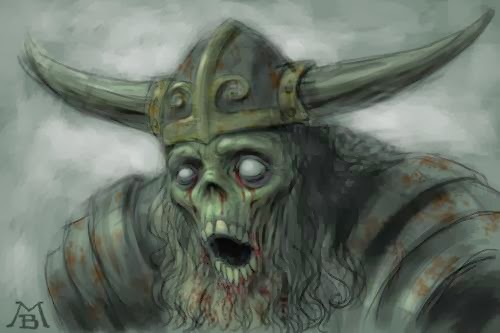
They have an unbearable stench of decay. They tend to be a blue or maroon hue. Are dressed in clothes of the Viking era. Tend to have long beards and hair (both usually white). They are large in size and quite heavy. They are extremely ugly and very decayed. Usually full of scars (these were probably battle wounds).
 
GENDER
Male
 
ALSO KNOWN AS
Draug, Draugur (Icelandic), Draugen (Norwegian, Swedish & Danish meaning "The Draug"), Aptrganga ("Afturgongur" in Modern Icelandic), Dreag (Gaelic)
 
REPELLED BY
In some tales, they can only be wrestled back into the grave. Iron can injure them but it is not enough to stop them. A pair of iron scissors would be placed on the chest of the recently deceased. The preferred way is to cut off their head, burn the body and dump the ashes into the sea. Their big toes would be tied together or have a needle through each of the soles, this stopped them from walking. A corpse door can also be used to keep them at rest. Fire is said to be quite effective as well.
 
MAGICAL POWERS/SKILLS
They possess superhuman strength, being able to increase their size and weight at will. They can also shape shift (usually into seals, cats grey bulls and horses), control the weather and see into the future. They are also able to enter the dreams of the living. Curses are also their favourite thing to do, causing sickness and disease.
 
HISTORY/ABOUT
Their name originally meant "ghost" but they are now seen more as animated corpses of the dead. The graves of important men were known to contain a good amount of wealth so they would guard their graves vehemently. They are undead Vikings who have retained some amount of intelligence. They delight in the suffering that they cause. They can rise from their graves as wisps of smoke, even being able to go through solid rock. Animals feeding near their grave may be driven mad by their influence. They slay their victims through various methods, such as crushing them, devouring them, drinking their blood or even driving them insane. They are more active at night time but they are not immune to the sunlight. They also haunt their families. They are immune to weapons, unless wielded by a man considered a hero. They are motivated by jealousy and greed. This is what causes them to viciously attack people. There are said to be 2 types, a sea Draugr and a land one.
 
CAN BE FOUND
They are believed to live in the graves of the dead. In a tomb that is more like a home to them.
 
TALES
Glamr is one of the best known in the whole world. He is found in the Grettis Saga. Thorolf of the Eyrbygga Saga was considered a Draugr. A shepherd is also killed by a Draugr and becomes one after in this saga. Thrain was a shape shifter in the Hromundar Saga "Griepssonar". The tale of Aran and Asmund is one about 2 sword brothers, one of whom dies and the other watches over him for 3 days. There is a legend in the Trondelag that tells the tale of a quarrel between 2 types of Draugr over a corpse on the beach.
 
ANY SIGHTINGS?
In 1911, a farmer disturbed a grave mound and a Draugr appeared and warned the farmer that if he took another shovelful, then there would be 6 cattle deaths and 6 deaths in his household. The Draugr was never seen again but the proclamation came true.
 
SIMILAR CREATURES
Zombies, Haugbui,
 

Sunday, 14 October 2012

Yuki Onna


ORIGIN
From Japanese folklore.
 
FIRST SIGHTED/RECORDED
There are tales from as early as the 18th century at least.
 
APPEARANCE
She is tall and very beautiful. She also has long black hair and blue lips. Their faces and skin is unnaturally pale, even appearing almost transparent. This helps her blend into the snowy landscape. She is sometimes seen wearing a white kimono, but at other times she is in the nude (with only her face, hair and pubic region standing out). Her eyes alone can strike terror into mortals. She floats across the snow, leaving no footprints. Some say that she has no feet (this is a common feature amongst Japanese ghosts).
 
GENDER
Female
 
ALSO KNOWN AS
"Lady of the snow", "Snow Queen" or "Snow ghost".
 
REPELLED BY
There doesn’t appear to be anything that she is repelled by but seeing as she displays some vampire characteristics, she may be repelled by some of the things used against them.
 
MAGICAL POWERS/SKILLS
She has the ability to turn people into ice. She also drains the life force of people.
 
HISTORY/ABOUT
They are associated with snow storms and winter in general. She is considered the spirit of snow itself. If she is threatened then she can transform herself into a cloud or some mist. She is said to be the spirit of someone who had perished in the snow. She is ruthless in the way she kills unsuspecting mortals. She can also invade homes by blowing down the doors and killing everyone inside (in some tales, she has to be invited in first). They are also seen as a Succubus like creature. They lure in young men to remote areas and either freeze them or drink their blood/life force. This can be done through either a kiss or sexual intercourse.
 
CAN BE FOUND
She is more likely to be found in places where the snow has settled or during a snowstorm.
 
TALES
In some legends, she appears to travellers who are trapped in the snow storms. She then uses her icy breath to turn them into frost coated corpses. In other tales, she leads them astray during the storm and leaves them to die of exposure. There is another tale in which she is seen holding a child. When a person then offers to "take" the child, she freezes them where they stand. There is a tale of how she was once a moon princess, who one day grew tired of the heavens. She came down to earth to explore and found that she could not return. She is featured in Lafcadio Hearn’s classic "Kwaidan" in 1901.
 
ANY SIGHTINGS?
There is always tales and footage from people who believe they saw something. I believe that it will always be one of those things that you won’t believe until you experience it.
 
SIMILAR CREATURES
Succubus, Vampire,
 

Friday, 12 October 2012

Trolls


ORIGIN
They are from Norse mythology and Scandinavian folklore.
 
FIRST SIGHTED/RECORDED
There is no clear date as to when the tales of Trolls first came around. They seem to be as old as time.
 
APPEARANCE
They are extremely ugly and old. They are also very slow witted but very strong. They can also look and behave just like humans. Sometimes their appearance can depend on their region. They can have tusks or cyclopic eyes. The males have poor intellect whereas the women are quite cunning.
 
GENDER
They can be either male or female.
 
ALSO KNOWN AS
Jotunn (this is a negative name for a Troll that is also used for Witches and Berserkers), Trow (Shetland and Orkney folklore), Troldfolk "Troll folk", Bjergtrolde "Mountain Trolls" and Bjergfolk "Mountain folk" (all from Denmark), Tusser (Norway).
 
REPELLED BY
In most tales they are repelled by sunlight. If they are exposed then they turn to rock. The same may go for false UV rays. They are also said to be frightened by lightening. The ringing of church bells causes them to leave for other lands, but before they leave, they will try and destroy the churches. In Scandinavia, they are known to fear iron.
 
MAGICAL POWERS/SKILLS
They are supernatural beings which gives them supernatural strength. They also apparently have the power of invisibility and are able to shape shift.
 
HISTORY/ABOUT
They are best known not only for their horrible appearance but their unhelpfulness to humans. They are considered to be very dangerous and are often referred to as man-eaters. They are known to live together in small family units (this is usually as father and daughter or mother and son). Even though they are quite recluse, they do have some form of social organization. They have a habit of BERGTAGNING (this is kidnapping or "mountain taking"), if they are not doing that then they are over running a farm or an estate. If they have not eaten the humans, then they may take them as their slaves. They are sometimes associated with particular landmarks; these can be explained as being formed from a Troll that was exposed to sunlight. They are not Christian.
 
CAN BE FOUND
They usually dwell in isolated places such as rocks, mountains or caves. Smaller Trolls can be found in burial mounds.
 
TALES
They are mentioned throughout the Old Norse Corpus. An unnamed Troll woman is mentioned in the PROSE EDDA book "SKALDSKAPARMAL". Numerous tales are recorded in Scandinavian folklore. Grendel, from the tale of Beowulf, is described as a Troll.
 
ANY SIGHTINGS?
A "Peg legged road Troll" was spotted in 1981 along the Tyson Mountain in Arkansas. There are numerous photos and video footage on the internet of people who have believed they have caught trolls, or troll like creatures, on film.
 
SIMILAR CREATURES
Changelings